



What are the Key Structural Initial Setup Factors for a Taller Retaining Wall that Requires Engineered Reinforcement?
A taller retaining wall installation—typically defined as any wall over four feet high—moves beyond a simple hardscape project and enters the realm of complex engineering. While shorter walls can rely primarily on gravity and base preparation, a taller wall is under immense, constant pressure from the earth it holds back. This pressure, known as sheer force and lateral stress, requires a specialized, concealed reinforcement system to prevent wall failure.
The most critical structural initial setup factor for these high-load structures is the integration of geogrid reinforcement. This engineered layering system is non-negotiable for walls holding back a significant slope. It provides the necessary tensile strength to permanently tie the visible structure back into the stable soil mass behind it, guaranteeing the structural integrity of the entire wall for a long-lasting installation.

The Science Behind Taller Walls: Why Geogrid is Essential
A traditional retaining wall relies on the friction of its blocks and the weight of the structure to resist the force of the retained soil. When a wall exceeds four feet, the mass and weight of the soil increase exponentially, making this method inadequate.
- The Threat of Sheer Force: Taller soil masses exert a powerful horizontal force (sheer force) that attempts to push the wall face outward. This is often exacerbated by saturated soil, which compounds the pressure with hydrostatic pressure.
- The Geogrid Solution: Geogrid is a high-strength polymer mesh that is laid horizontally and perpendicularly to the wall face. Its function is to provide the tensile strength—the ability to resist stretching or pulling—that the masonry blocks themselves do not have.
- The Soil-Wall Connection: By placing the geogrid back into the compacted soil, it mobilizes the weight of the earth behind the wall. This turns the entire soil mass into an active part of the retaining structure, creating a massive, stable wedge that the soil itself cannot push over.
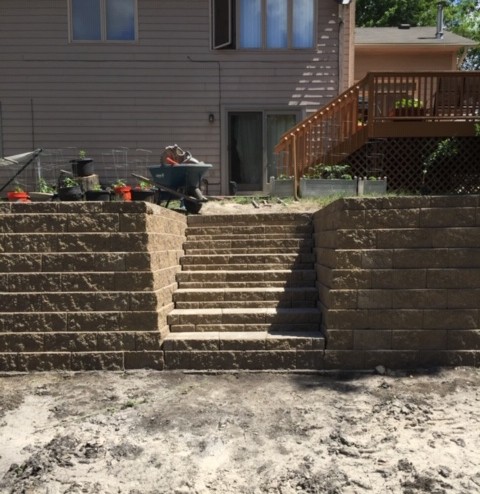
Key Structural Setup Factors for Geogrid Installation
A successful, engineered retaining wall installation is built on the precise placement and extension of the geogrid layers, as outlined by a professional engineer’s design.
- Precise Interval Placement: The geogrid must be installed at precise intervals between the block courses. The height spacing of these layers is dictated by the wall’s height and the soil type being retained. Typically, a layer is installed every two to three courses of block.
- Extended Back into the Compacted Soil: Each layer of geogrid must be rolled back a minimum distance—often 60% to 70% of the wall height—and extended back into the compacted soil. This embedment length is critical for anchoring the wall face to the stable mass behind it.
- Tightly Tied to the Wall Face: The geogrid is placed on top of one course of retaining wall block and then secured by the next course. The connection should be tight, with the grid pulled taut and secured before the next layer of backfill and block is placed.
- Integration with Proper Drainage: Even with geogrid, proper drainage is essential. The area immediately behind the blocks must be backfilled with clean, coarse aggregate (gravel), and a perforated drain pipe must be installed at the base, directing water away from the structure. This prevents water saturation from adding compounding hydrostatic pressure to the sheer force.
By integrating geogrid reinforcement at the correct intervals and ensuring the entire process is overseen by an expert Landscape Design team, Villa Landscapes guarantees a robust, long-lasting Retaining Walls structure. This engineered approach is the only way to safeguard your property against the powerful forces of the earth, ensuring your beautiful retaining wall installation provides a durable solution for decades.
Ready to start a custom, engineered Retaining Walls project that requires geogrid reinforcement?
Contact Villa Landscapes today to schedule your initial consultation.